
Views: 0 Author: Site Editor Publish Time: 2026-10-07 Origin: Site


Investing in a commercial agricultural structure dictates your total crop yield, daily energy expenditure, and long-term business profitability. For commercial growers, a Glass Greenhouse represents the pinnacle of controlled environment agriculture. It offers superior light transmission and exceptional structural longevity compared to temporary plastic alternatives.
As a structural engineer working with commercial growers, I see buyers make the same critical mistake over and over. They focus entirely on the initial price tag or the aesthetic appeal of the facility. In doing so, they overlook the underlying technical specifications that dictate how the building will perform under extreme weather conditions. This oversight consistently leads to poor weather resistance, inflated winter heating bills, and ultimately, crushed profit margins.
Current industry trends show a massive shift toward climate-resilient farming. With extreme weather patterns and severe summer heatwaves becoming the norm, commercial operators are abandoning standard, basic setups. The market now demands engineered light scattering, robust structural grading, and intelligent climate automation. Precision agriculture requires facilities that actively mitigate peak heat stress while driving deep canopy light penetration.
This guide serves as an ultimate technical checklist for prospective buyers. By carefully evaluating structural loads, glazing types, and crop-specific requirements, operators can mitigate risks, optimize their growing environments, and guarantee a robust return on investment.
Structural Integrity: Always verify the wind and snow load capacities of the primary framing. The structure must meet or exceed local municipal building codes to ensure worker safety and asset protection.
Glazing Matters: Prioritize 4mm tempered glass or high-haze diffused glass. These engineered materials provide optimal light transmission, often exceeding 90 percent, while adhering to stringent commercial safety standards.
Crop-Specific Customization: General specifications are never sufficient. Your technical parameters must align directly with your agricultural yield goals, whether you are cultivating delicate berries or managing complex hydroponic systems.
Climate Automation: Scrutinize the integrated specifications for ventilation, internal shading, and environmental control systems. Proper systemic integration directly dictates your energy efficiency and overall plant health.
The structural skeleton is the most critical specification to review before signing any purchasing agreement. Glass-clad buildings carry immense dead weight compared to standard poly-film alternatives. Consequently, the primary framing must be engineered to support this constant heavy load without settling or warping over time. Failing to verify these load-bearing specs guarantees catastrophic damage during severe weather events.
Commercial facilities typically utilize a strategic combination of two primary metals. Understanding the distinct role of each material ensures long-term durability. From a practical engineering standpoint, the robust feel of a facility comes from hot-dip galvanized steel used for the primary columns and trusses. This material provides exceptional load-bearing capacity. Buyers must explicitly check for a zinc coating specification of at least 275g/m² to prevent rust in high-humidity cultivation environments.
Furthermore, roof profiles and glazing bars are generally extruded from aluminum alloy. Aluminum is favored for these upper components because it remains lightweight yet incredibly rigid. It resists corrosion naturally and securely clamps heavy glass panels without adding unnecessary top-weight to the roof structure.
Understanding how to read load specifications is vital for structural survival. Buyers must ensure the architecture is explicitly rated for their specific geographic climate. Imagine a sudden winter blizzard. If the snow load rating, measured in kN/m², is inadequate, the entire roof could cave in under the accumulating weight. Similarly, coastal areas prone to severe storms require structural ratings engineered to handle hurricane-force wind loads. Always consult a structural engineer to cross-reference the manufacturer's load ratings with local meteorological data.
Water management is a structural priority. Proper drainage prevents foundation settling and mitigates interior disease vectors. Condensation naturally forms on the inside of cold glass during frosty winter mornings. Therefore, specialized internal condensation gutters must catch these droplets and channel them away. This prevents icy water from dripping onto the fragile crop canopy below. Externally, the main structural gutters must be sized to handle maximum local rainfall rates, ensuring water is rapidly diverted away from the foundation.
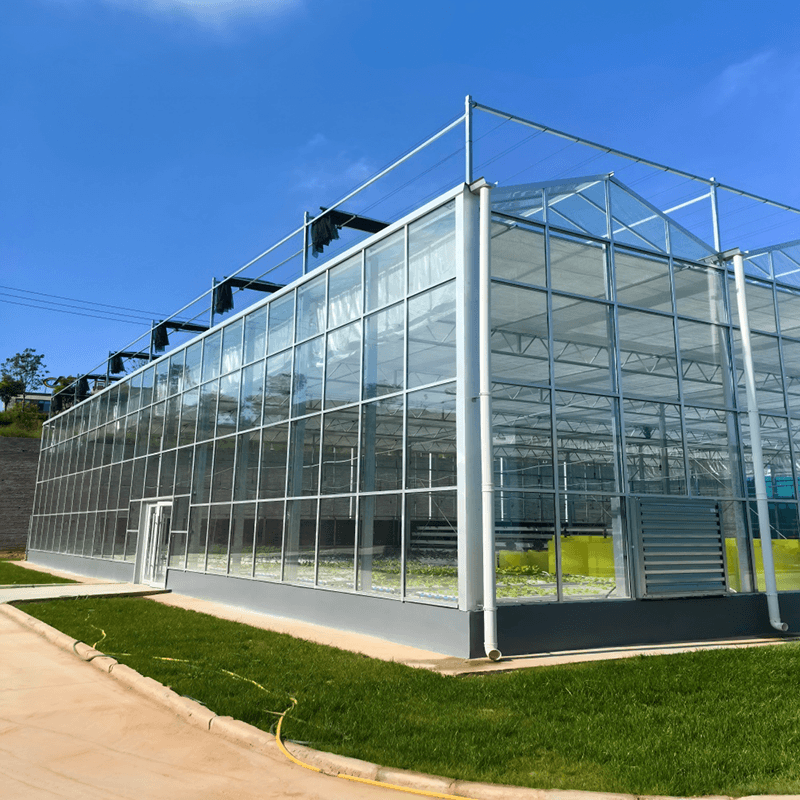
The transparent covering dictates both the light quality and the thermal efficiency of the entire facility. Selecting the correct glazing specifications is a delicate balancing act between maximizing light transmission, maintaining thermal insulation, and ensuring worker safety.
For commercial applications, standard annealed glass poses a severe safety hazard because it breaks into large, dangerous shards. Consequently, 4mm tempered glass is the mandated specification. The thermal tempering process makes the material four to five times stronger than standard glass. If tempered glass breaks due to severe hail or debris impact, it shatters into small, blunt fragments. This specifically protects both the agricultural workers inside and the valuable crops below.
Light transmission specifies the percentage of available Photosynthetically Active Radiation that successfully passes through the barrier. A standard commercial specification aims for greater than 90 percent transmission. However, clear glass can create harsh shadows and cause top-canopy burn. To solve this, buyers increasingly specify diffused glass. This material is manufactured with a textured surface that scatters incoming sunlight.
To make selection easier, refer to this core commercial glazing comparison:
Glazing Type | Light Transmission | Haze Level | Best Commercial Application |
|---|---|---|---|
4mm Clear Tempered | 90% - 92% | 0% | Low-light regions, crops requiring high direct sunlight. |
Low-Haze Diffused | 90% - 91% | 20% - 30% | General vegetables, moderate climate zones. |
High-Haze Diffused | 89% - 91% | 70% - 80% | Tall vining crops like tomatoes and cucumbers, high-sun regions. |
Double Glazing Hollow Glass | 78% - 82% | N/A | Extreme cold climates requiring maximum thermal insulation. |
A transparent structure traps solar radiation highly efficiently. Without proper ventilation and climate control specifications, the interior can quickly reach temperatures that are lethal to plants. Managing internal airflow and humidity is critical for preventing widespread crop loss.
Natural ventilation remains the most cost-effective way to regulate internal climates. Buyers should closely evaluate the ratio of the total ventilation area to the total floor area. A common specification for optimal passive cooling requires a vent area equal to 15 to 25 percent of the floor space. Specifically, look for continuous roof vents operated by reliable rack-and-pinion mechanical systems. These robust mechanisms provide precise control over the opening angle based on real-time wind speed.
Internal and external shading systems are necessary for controlling photoperiods and managing internal heat accumulation. Buyers should review two main specifications for thermal screens. First is the shading percentage, which indicates how much solar radiation is blocked during peak summer. Second is the energy-saving percentage, which indicates how effectively the screen retains heat during cold nights. Deploying an aluminum-woven energy screen at night prevents thermal radiation from escaping into the dark sky, drastically cutting heating costs.
When passive airflow is insufficient, active climate control systems must take over. Specifications for evaporative cooling pads and exhaust fans must match the total cubic volume of the facility. The system should be capable of replacing the entire air volume within approximately one minute. For heating in cold climates, hydronic hot water heating pipes are the engineering standard. They provide uniform, radiant heat directly near the root zones.
Different agricultural sectors require vastly different environmental conditions. A generic, off-the-shelf setup will inevitably fall short. Buyers must ensure that the architectural and systemic specifications align precisely with their chosen crop's biological needs.
Seedlings and young clones are highly vulnerable to environmental fluctuations. A single cold draft can stunt early root development. Therefore, a Nursery Glass Greenhouse requires strict microclimate control. Buyers should look for specifications that include rolling bench systems to maximize floor space utilization. Under-bench hydronic heating is critical here for promoting rapid propagation. Additionally, nurseries require high-pressure fogging systems operating at around 1000 PSI to maintain elevated ambient humidity without leaving standing water on delicate seedling leaves.
The cut flower industry relies on precise timing to force blooms for specific holidays. Consequently, a Commercial Floriculture Glass Greenhouse demands strict photoperiod control. Key specifications to check include automated blackout screen systems that can simulate short days, regardless of the external season. Diffused glazing is particularly important in this sector. Uniform light distribution ensures consistent stem lengths and vibrant, standardized bloom colors across the entire crop.
Growing tall, vining crops like tomatoes, cucumbers, or indeterminate berries requires specific architectural adjustments. A Fruit And Berry Glass Greenhouse must feature significantly taller eaves. Column heights of 5 to 7 meters are standard specifications in this sector to accommodate extreme vertical growth. Furthermore, the roof structure must boast heavy-duty load capacities to support the immense weight of mature fruiting vines hanging from trellising wires. Fine-mesh insect exclusion netting specs are also vital to protect high-value yields from external pests.
Hydroponic and aeroponic farming methods remove soil from the equation, relying entirely on nutrient-rich water solutions. A Soilless Glass Greenhouse requires highly precise structural grading. The foundation and internal flooring specifications must include specific slopes, usually 1 to 2 percent, to ensure proper gravity-fed drainage for the growing gutters. Buyers must also verify that the architectural plans allocate sufficient square footage for complex fertigation control rooms and integrated water sterilization equipment.
Modern commercial agriculture relies heavily on continuous data collection and automated, algorithmic responses. The specifications of your environmental control systems dictate how efficiently the facility operates day-to-day.
An automation system is only as effective as the data it receives. Buyers should scrutinize the technical specifications of all environmental sensors. Ensure the facility includes accurate sensors to measure the exact spectrum of light plants use for photosynthesis. Non-Dispersive Infrared sensors are required for precise carbon dioxide tracking. Meanwhile, temperature and humidity probes must be housed in aspirated boxes to shield them from direct sunlight, providing true ambient readings for Vapor Pressure Deficit management.
Ensure that all mechanical systems integrate seamlessly into a single centralized control panel. This includes roof vents, heating valves, blackout screens, and irrigation pumps. The specifications should confirm Internet of Things compatibility. This allows farm managers to monitor real-time data and adjust climate parameters remotely via secure cloud-based software platforms.
Given the high operational costs associated with year-round climate control, specifications that enhance energy efficiency and promote sustainable practices directly impact the facility's bottom line.
The U-value measures the rate of heat transfer. A lower number indicates superior insulation. Buyers must review the U-values for both the transparent panels and the metal framing. Because aluminum is highly conductive, the specifications should include thermal breaks. These are polyurethane or polyamide strips integrated into the extruded profiles. These components interrupt the thermal bridge between the cold exterior and the warm interior, dramatically lowering winter heating bills.
Sustainable irrigation practices require efficient water collection. Buyers should check if the external gutter specifications allow for seamless routing to massive external water storage silos. Collecting, filtering, and utilizing rainwater significantly reduces municipal water costs. It also provides crops with naturally soft water, which is ideal for mixing precise hydroponic nutrient solutions.
The final step in reviewing technical parameters involves verifying legal compliance and securing long-term financial protection for your capital investment.
Before any construction begins or deposits are paid, the manufacturer must provide detailed, stamped architectural blueprints. These specifications must comply strictly with local structural engineering codes, zoning laws, and agricultural regulations. The foundation specifications are particularly critical. Depending on soil composition, the engineering plans will specify exact depths for concrete pier foundations or continuous perimeter footings to guarantee stability.
A commercial cultivation facility is a major capital expenditure. Buyers should carefully review the warranty specifications provided by the manufacturer. Standard industry warranties typically offer 10 to 15 years of coverage on the structural integrity of the galvanized steel frame. This is usually paired with 5 to 10-year guarantees on the light transmission degradation of the glass panels and the functionality of mechanical parts. Understanding these terms ensures the facility remains a protected asset.
Stop guessing with your capital investments. Thoroughly checking the specifications of the structural frame, glazing materials, climate control systems, and crop-specific adaptations is absolutely non-negotiable for commercial success. By looking past the surface aesthetics and diving into the hard engineering data, operators can avoid costly retrofits and operational bottlenecks. A well-specified facility is a generational asset that will protect crops, optimize resource usage, and maximize yields for decades. Ready to build a high-yield commercial operation? Head over to https://www.jinghaoagri.com to consult with our dedicated greenhouse engineers and find the exact commercial structure tailored to your geographic climate and agricultural goals.
The industry standard is 4mm tempered glass. This specific thickness offers the perfect balance of high light transmission, durability against severe hail impacts, and necessary safety for agricultural workers. Thicker panes are rarely used as they unnecessarily increase the dead weight on the structure without providing proportional benefits to crop growth.
Wind load capacity depends entirely on your local municipal building codes and geographic location. Inland structures are typically engineered to withstand 70 to 90 mph winds. In contrast, coastal regions prone to hurricanes require heavy-duty structural framing engineered to handle 100 to 130 mph winds. Always verify these ratings with a certified structural engineer.
Diffused glass scatters direct, intense sunlight, transforming it into soft, even light that penetrates much deeper into the plant canopy. This prevents top-leaf burn during peak summer months and stimulates overall photosynthesis in the lower, shaded leaves. This consistent, engineered light distribution reliably leads to heavier fruiting, higher crop yields, and better overall plant health.
When engineered to the correct specifications using hot-dip galvanized steel and architectural-grade aluminum, a commercial structure can easily last 40 to 50 years. Achieving this maximum lifespan requires routine maintenance of the moving mechanical parts, such as rack-and-pinion vents, and periodic replacement of the rubber glazing seals.
While internal environmental systems like shading screens, hydronic heating loops, and smart automation sensors can be upgraded or retrofitted later, core structural specifications cannot be easily altered. Parameters like column height, wind load capacity, and foundation depth are permanent once poured. Therefore, it is crucial to get the structural engineering right from day one.


