
Views: 0 Author: Site Editor Publish Time: 2026-09-30 Origin: Site


Global agricultural markets face a relentless demand for premium, year-round commercial tomatoes. Meeting this escalating appetite requires a definitive transition toward precision agriculture. Cultivating commercial tomatoes at scale involves strict environmental regulation, exceptional light transmission, and significant vertical space. Traditional plastic hoop houses and low-tech structures often struggle to maintain these critical conditions consistently. Walking into a basic poly-tunnel on a hot July afternoon hits you instantly. The stifling, stagnant humidity breeds disease. It severely stresses your plants. The optimal solution for large-scale growers is the implementation of a modern Glass Greenhouse, which acts as a highly controlled manufacturing facility for biological growth.
Analyzing current industry trajectories reveals a definitive paradigm shift within the commercial tomato sector toward Controlled Environment Agriculture. Driven by increasingly erratic global weather patterns, prolonged regional droughts, and severe agricultural labor shortages, commercial producers are rapidly moving away from the inherent risks of open-field farming. Recent market evaluations indicate an accelerated consolidation phase. High-tech, automated glass facilities are heavily outpacing traditional agricultural methods. These advanced structures are no longer viewed merely as weather shelters. Instead, they operate as highly calibrated biological manufacturing plants. They are engineered to maximize yield per square meter while drastically minimizing water and fertilizer inputs.
Selecting the appropriate structural design is a critical bottom-of-funnel decision. This choice directly impacts long-term profitability, structural durability, and maximum crop yield. This comprehensive guide will evaluate the most effective architectural designs, material specifications, and hydroponic configurations. It provides actionable standards to assist commercial operators in choosing the ideal infrastructure for a profitable tomato enterprise.
The Venlo Design is the Industry Standard: Featuring a high roof, superior light transmission, and robust structural stability, the Venlo layout remains the primary choice for commercial tomato cultivation worldwide.
Hydroponics Maximize Yield: Implementing a soilless setup ensures precise nutrient delivery and water management. This substantially increases the tomato output per square meter compared to soil-based methods.
Diffused Glass is Crucial: The application of diffused or anti-reflective coated glass mitigates leaf burn and facilitates deep light penetration into the tall, dense tomato canopy.
High Initial Cost, Higher ROI: Despite a higher initial capital expenditure, the multi-decade lifespan and superior energy efficiency of glass structures yield excellent long-term financial returns.
Climate Control is Non-Negotiable: Automated ventilation, shading, and heating systems are fundamental requirements that must be integrated into the architectural blueprint from day one.
When evaluating structural materials for agricultural facilities, operators must consider the specific biological requirements of the target crop. For commercial tomatoes, glass structures offer distinct, measurable advantages over poly-film or polycarbonate alternatives. This superiority primarily stems from their optical clarity and structural resilience.
Unmatched Light Transmission
Tomatoes are inherently light-hungry crops. They require substantial daily light integrals to optimize photosynthesis and fruit development. Standard plastic films degrade, yellow, and cloud over time due to solar exposure. In stark contrast, standard agricultural glass provides up to 90 percent to 98 percent light transmission and maintains its pristine clarity. This ensures that consistent photosynthetically active radiation levels reach the plant canopy year after year, entirely eliminating the need for periodic roof replacements.
Longevity and Structural Durability
Agricultural investments require long-term reliability. A well-constructed glass facility boasts an operational lifespan easily exceeding 30 to 50 years with proper maintenance. Glass is completely resistant to ultraviolet degradation. This is a common issue that weakens flexible plastics and necessitates costly, labor-intensive replacements every few years. Furthermore, modern tempered glass supported by a hot-dip galvanized steel frame is engineered to withstand severe environmental stressors. Standard commercial specifications often feature wind load capacities up to 0.6 KN per square meter and snow loads up to 0.5 KN per square meter, providing a highly secure environment for valuable cash crops.
Superior Disease and Humidity Control
Fungal pathogens, particularly Botrytis cinerea and powdery mildew, pose a severe threat to commercial tomato yields. The structural rigidity of glass allows for a tightly sealed environment. This airtight construction facilitates the seamless integration of advanced heating, ventilation, and air conditioning systems. By maintaining strict control over the vapor pressure deficit, operators can drastically reduce the condensation that allows fungal spores to germinate and thrive.
Selecting the correct architectural framework is paramount. The skeletal design dictates the interior air volume, load-bearing capacity, and airflow dynamics. All these factors directly influence crop health and daily operational efficiency.
The Venlo Design: The Gold Standard
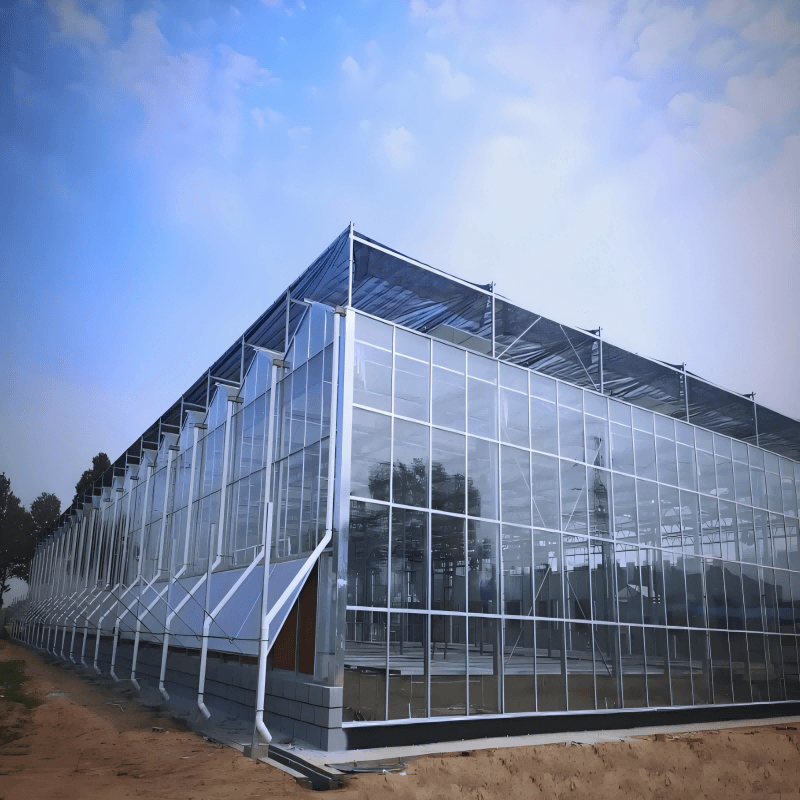
Originating in the Netherlands, the Venlo design is universally recognized as the optimal framework for commercial tomato production. Characterized by a multi-span layout, smaller roof panes, and exceptionally high gutters, this structure is engineered for maximum agronomic efficiency. Standard spans typically measure 8 meters, 9.6 meters, or 12 meters, allowing for highly efficient row spacing.
Indeterminate tomatoes are aggressive vine plants cultivated vertically on wire trellising systems. The elevated gutters of the Venlo design, usually ranging from 5 to 7.5 meters, easily accommodate these tall vines. This allows for extended growth cycles where vines can reach several meters in length. Additionally, the towering roof creates a massive interior air buffer. During peak summer days, hot, humid air naturally rises away from the plant canopy, stabilizing the microclimate at the crop level and preventing heat stress. Investing in a robust Commercial Vegetable Glass Greenhouse tailored to the Venlo specification ensures maximum spatial efficiency.
The Wide-Span A-Frame Design
The wide-span design features broader roof spans and steeper pitches compared to the Venlo model. From a practical standpoint, this architecture is particularly well-suited for geographic regions experiencing extreme winter weather. The steep pitch allows heavy snow to shed rapidly without accumulating and compromising the roof structure.
While it offers a massive interior volume for excellent climate buffering against sudden external temperature drops, the wide-span design generally requires heavier, thicker structural steel members to support the larger roof sections. Consequently, it is generally more expensive to construct per square meter than the highly optimized Venlo type.
Core Structural Comparison
Feature | Venlo Design | Wide-Span Design |
|---|---|---|
Typical Span Width | 8m, 9.6m, 10.8m, 12m | 12m, 16m, up to 20m |
Gutter Height | 5m to 7.5m | 4m to 6m |
Light Transmission | Excellent due to minimal steel shading | Good, but heavier trusses create more shadows |
Best Climate Fit | Moderate to high-heat climates | Heavy snow and extreme cold regions |
Cost Efficiency | Highly optimized, lower cost per sqm | Higher steel requirement increases cost |
Modern commercial tomato production has largely transitioned away from soil-based farming. Soilless cultivation minimizes soil-borne diseases, optimizes water usage, and allows for exact control over plant nutrition. However, integrating these systems requires specific structural considerations from the very beginning of the planning phase.
Dutch Bucket Systems
The Dutch bucket setup is a highly popular and effective method for commercial vine crops. In this configuration, individual buckets house one or two plants in a sterile, inert substrate like perlite or expanded clay pebbles. Nutrient solutions are delivered precisely via individual drip emitters. To make this work at a commercial scale, the greenhouse floor must be perfectly graded. Robust drainage trenches must be poured into the concrete foundation to capture and recycle nutrient runoff, ensuring strict environmental compliance and fertilizer resource efficiency.
Nutrient Film Technique and Rockwool Slabs
Instead of a tangled mess of drip lines on a dirt floor, modern operations often utilize rockwool or coco coir slabs. These slabs are laid out in precise rows along elevated metal gutters, providing a sterile, highly controllable root zone. Developing a precise Glass Greenhouse For Soilless Tomatoes requires careful coordination between structural engineers and agronomic consultants. The layout must allow for uniform irrigation lines and precise slope gradients to facilitate adequate drainage and prevent root rot.
Structural Requirements for Dynamic Loads
A mature commercial tomato crop carries significant water and fruit weight. The greenhouse roof trusses and gutter systems must be mathematically engineered to support the immense dynamic hanging load of fruit-bearing vines. This is often calculated at 15 to 25 kilograms per square meter, alongside standard wind and snow loads. Specifically, the facility design must incorporate a dedicated, climate-controlled headhouse. This vital area houses the fertigation mixing tanks, UV water sterilization units, and central computer systems required to automate nutrient delivery based on real-time solar radiation data.
The glazing material acts as the critical interface between your crop and the sun. Not all agricultural glass is created equal. Specific optical modifications can yield measurable increases in crop performance and operational safety.
Tempered Safety Glass
Standard float glass is brittle and poses a severe safety hazard to workers if shattered. For commercial applications, tempered safety glass is an absolute mandate. The tempering process makes the glass up to four times stronger than standard float glass. This provides critical resistance against hail strikes, high winds, and accidental impacts from heavy machinery operating inside the facility.
The Agronomic Power of Diffused Glass
Tomato plants develop dense, tall foliage structures. Standard clear glass transmits direct light, which casts harsh shadows within the plant. This often leads to upper leaf burn during peak summer months while leaving the lower canopy shaded and unproductive. Diffused glass is manufactured with microscopic patterns that scatter incoming solar radiation. High-quality diffused glass typically features a haze factor between 20 percent and 70 percent. This scattering effect ensures that light penetrates deep into the lower leaves, activating photosynthesis throughout the entire plant. Agronomic studies estimate this deep canopy penetration reduces plant stress and increases overall fruit yield by 5 percent to 10 percent.
Anti-Reflective Coatings
To further maximize light transmission, manufacturers can apply anti-reflective coatings to the glass surface. Standard glass naturally reflects a small percentage of sunlight away from the roof. Anti-reflective coatings minimize this reflection, increasing total light transmission by an additional 2 percent to 3 percent. In the highly competitive commercial tomato market, investing in a high-transmission Vegetable Glass Greenhouse translates to a proportionate and highly profitable increase in total fruit output.
A glass structure is essentially a highly efficient solar collector. Without robust, automated climate control systems, the interior environment would quickly become lethal to sensitive tomato plants. Precision agriculture relies entirely on these integrated technologies.
Pipe Rail Heating Systems
Tomatoes are warm-season crops requiring consistent nighttime temperatures to develop high-quality fruit. The industry standard is the pipe rail heating system. A network of hot water pipes is installed along the floor between the crop rows. When workers navigate the aisles on motorized scissor lifts to prune or harvest, this pipe rail system serves a dual purpose. It acts as physical tracks for the machinery, while simultaneously providing gentle, radiant heat directly to the lower canopy to aid in transpiration and keep the foliage dry.
Active Ventilation and Cooling
Maintaining an ideal daytime temperature range of 21 to 28 degrees Celsius is essential for proper fruit set and avoiding blossom drop. Continuous or staggered roof vents, a hallmark of the Venlo design, allow for rapid passive air exchange and humidity release. In hotter, more arid climates, passive ventilation is often supplemented with active pad-and-fan cooling systems. These systems draw outside air through wet cellulose pads, dramatically lowering the interior temperature via evaporative cooling.
Automated Shade and Energy Screens
Automated internal screening systems are vital for both energy management and crop protection. Thermal screens are deployed horizontally below the roof at night to trap heat close to the crop. This significantly reduces boiler fuel consumption by up to 40 percent during colder months. Conversely, during peak summer days, aluminized shade cloths are drawn to reflect excess solar radiation, preventing the greenhouse from overheating and protecting the tomatoes from sunscald and fruit cracking.
Transitioning to a commercial glass facility requires careful financial planning. Growers must evaluate both the upfront capital requirements and the long-term operational savings to understand the true trajectory of their return on investment.
Initial Capital Expenditure
Constructing a commercial facility requires a substantial upfront investment. The primary cost centers are generally distributed across the hot-dip galvanized steel framing, specialized tempered glazing, advanced hydroponic infrastructure, and sophisticated climate control technology. Site preparation, grid connections, and specialized construction labor also contribute significantly to the initial capital expenditure.
Operational Expenditure Savings
While the initial construction cost is undeniably high, a well-designed glass structure offers substantial operational savings over its lifetime. The superior insulation properties of tightly sealed glass, combined with automated thermal screens, dramatically lower heating costs compared to poorly insulated plastic structures. Furthermore, the longevity of glass eliminates the recurring material and labor costs associated with replacing plastic poly-film every three to five years.
Yield and Profitability Timeline
The primary driver of ROI in a glass greenhouse is the exponential increase in output volume and product quality. Traditional open-field tomato farming might yield 6 to 8 kilograms per square meter annually. In stark contrast, a climate-controlled, hydroponic glass facility can consistently yield 60 to 80 kilograms per square meter. This represents a tenfold increase. Coupled with the ability to supply premium, blemish-free tomatoes during off-season months when market prices are at their peak, commercial operators typically achieve a break-even point within three to seven years.
The success of your agricultural enterprise relies heavily on the expertise, engineering capabilities, and reliability of your greenhouse manufacturing partner. Selecting the right supplier is just as important as selecting the right tomato variety.
Customization and Engineering Capabilities
Every commercial project faces unique geographic, climatic, and agronomic challenges. A competent manufacturer must possess an in-house engineering team capable of tailoring the structure to your specific needs. This includes customizing gutter heights for specific vertical vine varieties, and reinforcing the steel framing to meet strict local building codes for wind and snow load ratings.
Turnkey Solutions vs. Structure-Only Providers
For complex commercial operations, piecing together components from different, unrelated suppliers can lead to catastrophic integration failures. Buyers are strongly advised to seek manufacturers capable of providing comprehensive turnkey solutions. A turnkey provider will engineer the steel structure, the hydroponic systems, and the climate control technology to work seamlessly together as a single, unified ecosystem. This minimizes compatibility issues and streamlines project management.
Warranty and Post-Installation Support
Commercial greenhouses are massive capital investments that must operate flawlessly for decades. Scrutinize the warranties offered by the manufacturer. Operators should look for comprehensive guarantees on the steel galvanization process and the light transmission longevity of the glass panels. Ensure the manufacturer provides robust technical support and troubleshooting for the environmental control software long after the physical installation is complete.
For commercial tomatoes, the Venlo-style glass structure equipped with diffused glass and modern hydroponic systems stands as the undisputed champion. While the initial financial commitment is significant, the unmatched precision, exponential crop yield, and multi-generational longevity make it the most profitable choice for serious commercial agriculture. To explore how these advanced systems can elevate your production, browse our catalog of tailored Hydroponic Glass Greenhouse solutions and start planning your next high-yield commercial project today.
The Venlo glass greenhouse is widely considered the optimal architectural design. Its exceptionally high gutters allow for extended vertical vine growth, while its roof structure provides maximum light transmission and creates a large interior air buffer for excellent temperature and humidity management.
Yes, but the structure must be specifically engineered from the planning phase to support the additional hanging weight of mature, fruit-bearing vines. It must also accommodate the complex plumbing, sloped grading, and drainage trenches required for a commercial hydroponic setup.
For optimal commercial production, the gutter height should be at least 5 to 7.5 meters. This allows ample vertical room for indeterminate tomato vines to grow along trellises and ensures hot air accumulates well above the sensitive plant canopy.
While clear glass is functional, diffused glass is highly recommended for tall, dense crops like tomatoes. It prevents the upper leaves from suffering light burn and scatters solar radiation so it reaches the lower canopy, which can increase overall fruit yields by an estimated 5 percent to 10 percent.
With routine maintenance, the hot-dip galvanized steel framework and tempered safety glass can easily remain operational for 30 to 50 years. This longevity makes it a highly durable, multi-generational agricultural asset compared to plastic structures that require frequent recovering.
Commercial tomatoes thrive in daytime temperatures ranging from 21 to 28 degrees Celsius, with nighttime temperatures dropping slightly to 15 to 18 degrees Celsius. The ideal relative humidity should be maintained between 65 percent and 75 percent to promote healthy transpiration while preventing fungal diseases.
In standard commercial hydroponic setups, row spacing is typically designed around 1.6 to 1.8 meters from center to center. This spacing allows adequate light penetration into the lower canopy and provides sufficient room for pipe rail heating systems and motorized harvest carts to operate efficiently in the aisles.


