
Views: 0 Author: Site Editor Publish Time: 2026-08-31 Origin: Site


Greenhouse glazing acts as the single most critical variable dictating long-term HVAC energy consumption, light quality, and overall crop yield. Facility operators constantly face the challenge of balancing competing physical properties. You must maximize Photosynthetically Active Radiation (PAR) while maintaining high thermal resistance (R-value). At the same time, the structure needs to withstand local weather extremes, heavy snow loads, and maintain strict insurance compliance. Choosing the right panels requires a technical evaluation framework rather than guesswork. We will break down the exact specifications required for specific climates, crop types, and structural designs. By understanding the physical limitations and advantages of different glazing materials, you can engineer a growing environment that directly supports higher yields. This guide provides the field-tested data needed to select the exact polycarbonate specifications required for your specific agricultural operation.
Thickness dictates thermal efficiency but reduces light: Multi-wall panels increase R-value for cold climates but incrementally decrease direct light transmission.
UV protection is non-negotiable: Only panels with co-extruded UV layers prevent rapid degradation, yellowing, and brittleness.
Coatings impact crop health: Anti-condensate (anti-drip) technology is required to prevent water droplets from blocking light and spreading fungal diseases.
Structural alignment matters: Panel choice must align with the architectural framework, particularly in high-efficiency commercial setups like a Venlo polycarbonate greenhouse.
Safety and compliance drive commercial viability: Fire ratings and wind-load certifications are critical for securing commercial insurance and meeting local building codes.
Direct light hits the plant canopy from a single angle. This often causes upper leaf burn and heavily shades the lower foliage. Diffused light scatters upon entering the structure. This scattering effect allows photons to penetrate deeper into the plant canopy, hitting lower leaves and improving overall photosynthesis. You must establish baseline Photosynthetically Active Radiation (PAR) requirements based on your specific crop. High-wire tomatoes demand maximum light transmission to support rapid fruiting and heavy biomass production. Low-light ornamentals thrive under higher haze factors where direct sun exposure causes physical damage to the leaves. Evaluate the specific light requirements of your primary crop before looking at panel specifications.
Crop Type | Recommended Light Transmission | Ideal Haze Factor (Diffusion) | Glazing Priority |
|---|---|---|---|
High-Wire Tomatoes / Cucumbers | 85% - 90%+ | High (60%+) | Maximum PAR penetration to lower canopy |
Leafy Greens / Lettuce | 75% - 85% | Medium (40% - 60%) | Consistent light levels, moderate insulation |
Cannabis (Flowering) | 85%+ | High (70%+) | Deep canopy penetration, strict environmental control |
Propagation / Clones | 60% - 70% | Very High (80%+) | Burn prevention, high thermal retention |
Heat retention directly impacts your winter heating and summer cooling expenses. R-value measures thermal resistance. U-value measures thermal transmittance. A higher R-value means better insulation, while a lower U-value indicates less heat escaping the structure. You face a constant physical trade-off here. Thicker panels offer superior insulation but reduce overall light transmission. Evaluate your local climate data to find the optimal balance between heating requirements and light loss. A facility in a northern climate requires a completely different thermal strategy than an operation in a desert environment.
To calculate your baseline thermal requirements, follow these steps:
Determine the lowest average winter temperature for your specific geographic zone.
Identify the minimum nighttime temperature required for your specific crop to prevent cold stress.
Calculate the Delta-T (the difference between outside and inside temperatures).
Select an R-value that minimizes BTU loss without dropping PAR below the crop's minimum threshold.
Environmental stressors dictate panel rigidity and thickness requirements. Static snow loads can crush weak roofs during heavy winter storms. Dynamic wind loads cause panels to flex, potentially popping them out of their aluminum frames. Hail impact ratings determine survival during severe weather events. Analyze historical weather patterns in your specific region. Select a panel thickness and internal flute geometry capable of withstanding these local forces without compromising structural integrity. You must account for both dead loads (the weight of the structure itself) and live loads (snow, wind, and hanging equipment).
When engineering a polycarbonate panel greenhouse, you must select the correct sheet profile. The market offers several distinct categories, each serving a specific agricultural function.
Multi-wall sheets utilize internal structural geometry to trap air. These flutes, channels, or X-bracing patterns create insulating air pockets while adding significant structural rigidity. An 8mm twin-wall sheet serves as the standard for commercial vegetable production in moderate climates. Extreme cold climates often require 16mm or thicker multi-wall configurations to prevent excessive heat loss. The complex internal geometry of thicker panels heavily diffuses light. This benefits tall canopy crops but requires careful PAR monitoring.
Panel Thickness & Structure | Approximate R-Value | Light Transmission (Clear) | Best Use Case |
|---|---|---|---|
8mm Twin-Wall | 1.60 | 80% - 82% | Standard commercial vegetables, moderate climates |
10mm Twin-Wall | 1.75 | 79% - 81% | High wind areas requiring extra rigidity |
16mm Triple-Wall | 2.50 | 74% - 76% | Cold climates, year-round growing |
16mm Five-Wall / X-Structure | 2.80+ | 60% - 65% | Extreme winter environments, propagation houses |
Single-layer corrugated sheets offer exceptionally high light transmission, often reaching up to 90%. The corrugated profile provides excellent impact resistance against hail and flying debris. However, these thin sheets offer very poor thermal retention. They fail to trap heat effectively during cold nights. Limit corrugated sheets to mild climates, unheated high tunnels, or interior partition walls where insulation is not a primary operational concern. The overlapping installation method for corrugated sheets does make them highly resistant to water ingress on low-pitch roofs.
Solid polycarbonate mimics the appearance of traditional glass. It offers incredible impact resistance, rating roughly 200 times stronger than standard glass. Clarity remains exceptionally high. However, solid sheets lack the trapped air pockets found in multi-wall designs. This results in a much lower insulation value. Solid sheets also carry a significantly higher upfront material cost compared to multi-wall alternatives. This makes them less common for large-scale agricultural roofing, though they remain popular for high-impact side walls or retail display areas.
Clear panels maximize total light transmission. They work best for high-light crops and northern climates with short winter days. Opal or white panels diffuse light heavily and reduce solar heat buildup. Use these in propagation houses or for shade-loving plants. Bronze or tinted panels significantly reduce both solar heat gain and light transmission. These tints typically serve retail garden centers or specific architectural applications where human comfort outweighs crop photosynthesis.
Raw polycarbonate degrades rapidly under ultraviolet radiation. Manufacturers protect the polymer using either spray-on coatings or co-extrusion. Co-extruded UV protection integrates directly into the polymer during the manufacturing process. This method proves vastly superior to topical coatings. It prevents micro-cracking, yellowing, and light transmission loss over a 10 to 15-year lifespan. Always verify the presence of a co-extruded UV layer on the sun-facing side before finalizing any material purchase. Installing a panel backward will result in complete material failure within 24 months.
Temperature differentials create condensation on the inner surface of greenhouse glazing. Standard polycarbonate has high surface tension, causing water to form large droplets. These droplets block incoming sunlight and eventually drip onto the plant canopy below. Dripping water rapidly spreads fungal diseases like Botrytis. Anti-condensate layers alter the surface tension. This forces moisture to sheet out and run down the panel safely into the gutter system, protecting the crop below.
Modern manufacturing allows for light-diffusing additives directly within the polymer matrix. These additives scatter incoming direct sunlight. The resulting diffused light penetrates much deeper into the plant canopy. It reduces internal structural shadows and prevents upper-leaf burn during peak summer months. Enhanced light distribution improves overall photosynthetic efficiency across the entire crop volume. This leads to higher yields and more uniform plant growth without requiring supplemental lighting.
Commercial agricultural facilities must adhere to strict fire safety regulations. Flammability ratings directly impact your ability to secure commercial insurance. Look for panels carrying ASTM E84 Class A or CC1/CC2 ratings. Polycarbonate naturally possesses self-extinguishing properties. It melts away from the heat source rather than spreading flames. Documenting these fire ratings often leads to more favorable insurance premiums and ensures compliance with local building codes.
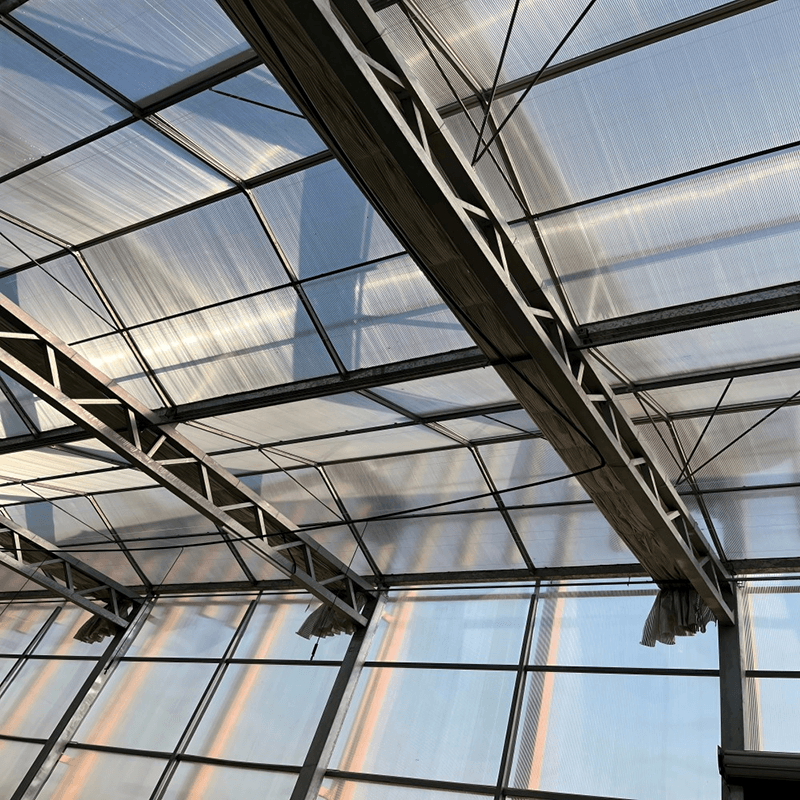
Building a Venlo polycarbonate greenhouse requires precise engineering to match the glazing with the steel framework.
The Venlo design remains the industry standard for large-scale commercial agriculture. It features a robust galvanized steel structure with smaller roof pitches. This design maximizes light transmission while minimizing the structural footprint. The narrow roof spans handle heavy snow and wind loads efficiently. Integrating multi-wall panels into this framework creates a highly efficient growing environment capable of supporting massive commercial yields. The standardized grid system allows for rapid expansion as your operation scales.
Securing multi-wall polycarbonate into a Venlo PC sheet greenhouse requires specific aluminum extrusion systems. You must account for panel dimensions and weight tolerances. Polycarbonate weighs significantly less than heavy horticultural glass. This lightweight nature provides distinct structural load benefits. It allows for lighter structural steel components, which in turn reduces overhead shading. The entire framework becomes more efficient to construct. You must ensure the glazing bars feature deep channels to capture the panel edges securely during high wind events.
Replacing aging glass with polycarbonate panels on an existing structural frame requires careful engineering. You cannot simply swap the materials. Polycarbonate has a much higher expansion rate than glass. You must adjust glazing bars and install proper rubber gaskets to accommodate this movement. Failure to account for thermal expansion during a retrofit will result in warped panels, compromised seals, and eventual structural failure during extreme temperature shifts.
Thicker, high-performance panels require a larger upfront investment. However, this initial capital expenditure directly reduces long-term operating expenses. Model your projected energy savings based on the improved R-value. Calculate the payback period by comparing the extra upfront material cost against the reduced monthly heating bills. In cold climates, thicker panels often pay for themselves within the first few winter seasons through massive reductions in natural gas or propane usage.
Deconstruct manufacturer warranties carefully. A 10-year warranty rarely covers total structural failure. Instead, it usually defines failure as a specific percentage loss in light transmission or a defined increase in the yellowing index. Understand exactly what metrics trigger a warranty claim. A panel may remain structurally intact but become so yellowed that it severely stunts crop growth. This renders it useless for commercial agriculture despite technically remaining in one piece.
Cleaning polycarbonate requires specific protocols to avoid damaging the protective layers. You cannot use abrasive brushes or harsh chemicals. Improper cleaning quickly degrades the UV protection and strips away the anti-drip coating. Assess the labor required for gentle washing routines. Use only manufacturer-approved cleaning solutions to maintain light transmission without voiding the warranty. Factor these specialized maintenance routines into your annual operating budget.
Consider the sustainability aspect at the end of the 10 to 15-year lifecycle. Polycarbonate panels are fully recyclable. However, you must factor in the labor to dismantle the roof and the logistics of transporting the material to a commercial recycling facility. Compare these disposal logistics against local landfill regulations to plan for the true end-of-life process. Proper planning prevents unexpected disposal costs when it comes time to re-glaze the facility.
Polycarbonate expands and contracts significantly with temperature fluctuations. If constrained tightly, the panels will buckle, warp, or pop out of their aluminum frames. Mitigate this risk by drilling oversized holes for any fasteners. Use specialized glazing bars designed specifically for plastics. Install high-quality EPDM rubber gaskets that allow the panel to slide slightly as it expands during hot summer afternoons and contracts during freezing nights.
Multi-wall flutes must always run vertically. This orientation allows internal condensation to drain out the bottom of the panel. Installing ribs horizontally traps moisture permanently, leading to algae growth. Furthermore, specify a minimum roof pitch of at least 2/12 (roughly 10 degrees). A sufficient pitch ensures that external rain washes away dust and internal condensation flows smoothly down the anti-drip layer into the gutter system.
Open flutes invite dust, insects, and moisture. You must seal the ends correctly to prevent internal algae growth.
Apply solid aluminum tape across the top edge to block water ingress completely.
Apply breathable vent tape along the bottom edge.
Ensure the U-profile closure at the bottom has weep holes drilled every 12 inches.
Never use standard duct tape or masking tape, as they degrade rapidly under UV exposure.
This specialized bottom tape keeps insects out while allowing trapped internal condensation to evaporate and drain away. Proper taping extends the optical clarity of the panel by years.
Common Failure | Root Cause | Mitigation Strategy |
|---|---|---|
Internal Algae Growth | Improper flute sealing or horizontal installation | Use breathable vent tape on the bottom edge; ensure vertical flute orientation. |
Panel Buckling | Insufficient thermal expansion allowance | Drill oversized fastener holes; use EPDM rubber gaskets. |
Micro-cracking (Crazing) | Chemical incompatibility | Use only 100% silicone sealants; avoid PVC contact. |
Rapid Yellowing | Panel installed backward (UV side facing in) | Verify the printed UV-protected side faces the sun during installation. |
Polycarbonate reacts poorly to certain chemicals. Incompatible sealants, PVC gaskets, or wood preservatives cause chemical crazing. Crazing manifests as a network of tiny micro-cracks that destroy the panel's structural integrity. Only use 100% silicone sealants explicitly rated for polycarbonate. Avoid direct contact with flexible PVC, which releases plasticizers that degrade the glazing over time. Verify chemical compatibility for all construction materials touching the panels.
Request technical data sheets (TDS) from manufacturers to verify exact light transmission percentages and R-values before finalizing any material orders.
Consult with a licensed structural engineer to confirm that your selected panel thickness and glazing bar spacing meet local wind and snow load requirements.
Order physical material samples to inspect the rigidity, flute geometry, and anti-drip coating quality firsthand.
Verify the chemical compatibility of all sealants, gaskets, and structural paints that will come into direct contact with the polycarbonate panels.
A: An 8mm twin-wall panel serves as the standard for most commercial applications, offering a strong balance of light transmission and insulation. For extreme cold climates, upgrade to 16mm or thicker multi-wall panels to reduce heating costs. Hobby structures or mild climates can utilize thinner 4mm or 6mm panels.
A: A high-quality polycarbonate greenhouse realistically lasts 10 to 15 years before experiencing significant light degradation. This lifespan depends heavily on the presence of a co-extruded UV protection layer. Without proper UV defense, the plastic will yellow, become brittle, and fail much faster under direct sunlight.
A: Polycarbonate offers superior impact resistance, better thermal insulation, and excellent light diffusion compared to standard glass. It is also much lighter, reducing structural load requirements. However, glass provides absolute clarity and multi-decade longevity that plastics cannot match, making the choice dependent on your specific climate and structural budget.
A: You must purchase panels manufactured with a factory-applied anti-drip (anti-condensate) coating. During installation, ensure the multi-wall flutes run vertically to allow drainage. Finally, apply breathable vent tape to the bottom edge of the panels so trapped internal moisture can escape.
A: No. Standard architectural polycarbonate lacks the specialized anti-condensate coatings and robust UV treatments required for agricultural environments. Using regular sheets will result in severe condensation dripping onto your crops, rapid yellowing from intense sun exposure, and premature structural failure.
A: It is a commercial structure combining the highly efficient Venlo architectural design—known for its robust galvanized steel frame and narrow roof pitches—with polycarbonate sheeting. This pairing maximizes commercial efficiency by providing excellent light uniformity, superior thermal retention, and reduced structural weight compared to traditional glass setups.


